
Religious women are fully human, graced to share in the divine. They are not born qualified; God is the one who qualifies them. The phrase “Piga simu Assumbi” meaning “call Assumbi” has gone viral in recent days. This came after a video surfaced showing one religious sister hurling insults and slapping a fellow sister in front of lay employees. Such a scene feels shocking. It is unexpected of a sister. Yet, it is not impossible, because a sister is first human.
She failed. Why? Because she allowed her emotions to control her. She could have chosen to walk away, but anger overwhelmed her. She wanted to prove a point. And she proved it, through the slap and the verbal abuse. Sadly, it all ended as a nightmare. Now, she has nowhere to hide her face. But not just her, the entire community of religious women and the Catholic Church find themselves under scrutiny, because the internet never wastes an opportunity to vent.
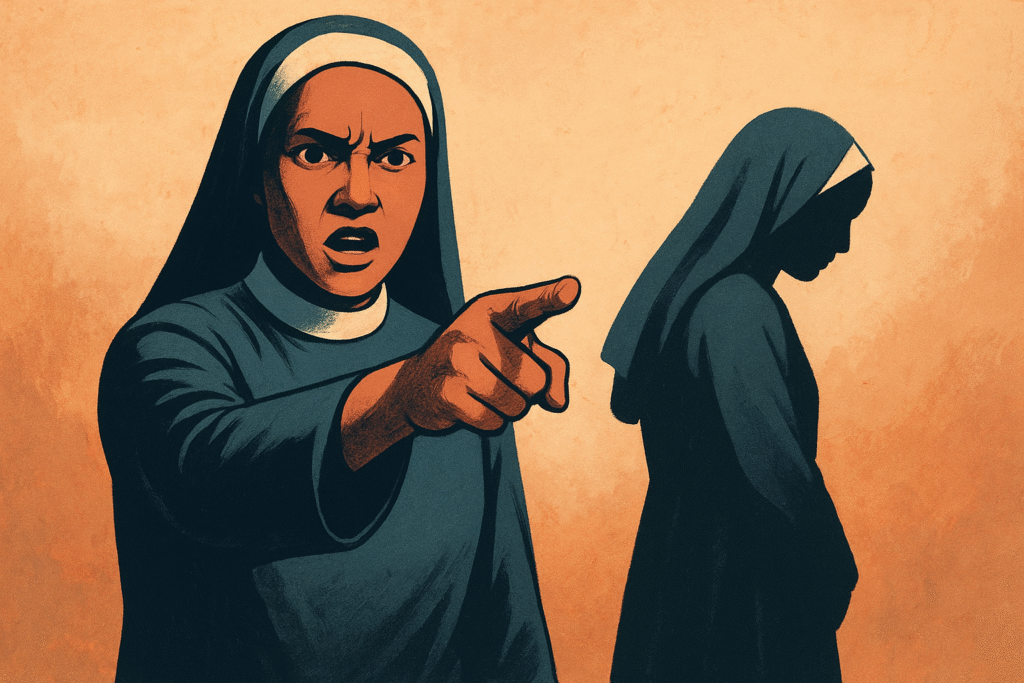
I do not agree with what this alleged sister did. I do not support abuse, be it physical, verbal, emotional, or whatever you want to call it. But should we not also have a bit of empathy?
Has anyone stopped to ask what could have prompted her actions? Religious women come from families too, some from broken ones. Some have grown up in abusive environments, carrying unspoken pain because they had no one to confide in. Some come from struggling families and still carry those burdens, often without the courage to open up for fear of judgment.
Society expects too much from religious women. We see their smiles, but rarely notice the pain behind those smiles. When was the last time you genuinely checked on a religious woman?
Yes, the sister in question made a huge mistake. But should her mistake be used as an excuse to attack all religious women? Is it right to brand all religious with names because of one person’s fault, without evidence? Do we realize that by doing so, we become abusers too, just like the very abuser we condemn?
Her actions, however regrettable, are a lesson for all religious to learn from. They remind us that the habit does not erase human weakness, and that every sister, brother, or priest is called daily to grow in patience, humility, and charity. This painful incident is a lesson for the whole Church: to be slow to anger, to bear with one another in love, and to seek healing where wounds exist.
It is time we learn to attack the mistake, not the person. No one deserves to be abused. Religious women do not deserve abuse either. Stop being abusers in the name of advocating for justice. Catholic Social Thought reminds us of the inherent dignity of every human person: “The dignity of the human person is rooted in his creation in the image and likeness of God” (Catechism of the Catholic Church, 1700). Justice demands that we condemn the wrong action, but charity demands that we continue to respect the person. As Pope Francis taught, “Forgiving does not mean forgetting… but it does mean not allowing ourselves to be consumed by the same destructive force that caused us so much suffering” (Fratelli Tutti, 207). To condemn the abuse is to uphold what is right; to condemn the person is to deny the possibility of healing, reconciliation, and growth.

1 comment
This piece really moved me. What Okanga does here is quietly radical—she’s asking us to do something that feels almost countercultural right now: hold someone accountable while still seeing them as fully human.
I think what makes this work so well is that she’s not making excuses. She says plainly that the sister was wrong, that abuse is abuse, no question. But then she does something harder. She asks us to pause and wonder what might be going on beneath the surface. Has this sister been carrying pain from her family? Is she exhausted by expectations she can’t possibly meet? These aren’t justifications—they’re invitations to understand.
There’s something really compassionate about how she calls out our own cruelty too. The way we pile onto moments like this online, the way we use one person’s mistake to condemn an entire group—Okanga names that as its own form of harm. And she does it without making us feel attacked, just… gently challenged.
What struck me most was when she talks about seeing the smiles of religious women without noticing the pain behind them. It’s such a simple observation, but it cut through all the noise. These are real people—people who might be struggling, who might have nowhere to turn. The internet doesn’t care about that complexity. Okanga does.
The theological part feels genuine too, not forced. When she talks about the dignity of every person, it’s not just doctrine—it feels like something she actually believes and wants us to consider.
If I’m honest, I wish she’d explored what comes next. What does accountability actually look like? How do we heal from something like this? But maybe that’s the point—maybe she’s asking us to sit with the harder questions rather than rushing to answers.
It’s writing that asks more of us than usual. And that’s a good thing.