
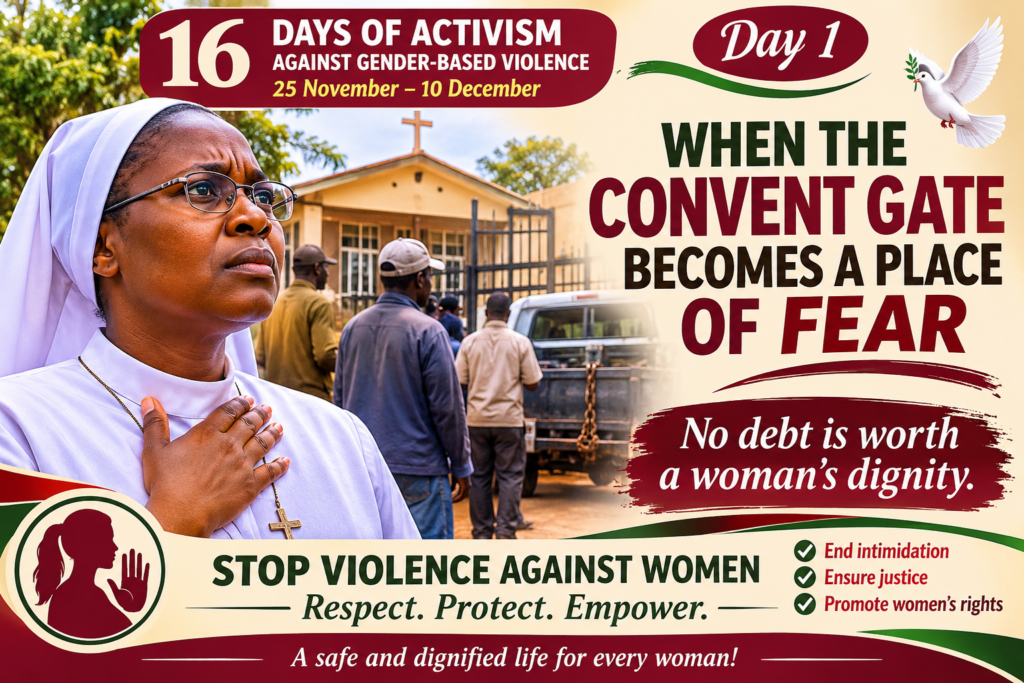
As the world observes the 16 Days of Activism against Gender-Based Violence, an alleged incident at a convent in Kenya reminds us that violence against women can take many forms. It can involve physical force, intimidation, threats, humiliation and the abuse of institutional or economic power.
According to accounts from the Sisters, more than six men arrived at the convent in an open truck carrying chains. They claimed that a member of the religious congregation had been involved in a road accident in Ol Kalou and was required to pay compensation for the damage. The Sisters say they were hearing the claim for the first time. They also maintain that the person allegedly involved in the accident was not a member of their community.
What followed was deeply disturbing. The men allegedly forced open one of the Sisters’ vehicles and attempted to attach it to their truck. When they were unable to tow it through the locked gate, they reportedly waited outside.
Shortly afterwards, another Sister arrived at the convent in a small van. According to the account, the men surrounded her, pulled her from the vehicle and confronted her with accusations. One of the men allegedly entered the vehicle while another attached chains to it. The vehicle was then driven away.
Whether the underlying compensation claim was genuine is a matter that should be established through proper investigation. But one principle must remain clear: no debt-recovery process should expose women to fear, humiliation or physical force.
A lawful claim does not justify unlawful conduct. Debt recovery must take place through transparent and legally authorised procedures. Those involved must be able to present the relevant documentation, identify the person against whom the claim is made and explain the legal authority under which property is being taken. They must not use intimidation as a substitute for due process.
A convent should be a place of prayer, service and safety. It should not become a place where women fear being surrounded, dragged from vehicles or confronted by strangers. Women in religious communities are not outside the protection of the law. Their choice to live a consecrated life does not make their dignity less important or their safety less deserving of protection.
This incident also raises broader questions about the treatment of women in spaces that are often overlooked in conversations about gender-based violence. Violence against women does not occur only in homes. It can also occur in workplaces, public spaces, institutions and religious communities. It can be carried out through physical force, threatening behaviour, coercion or the misuse of authority.
That is why the response must go beyond condemnation. The incident should be properly investigated. The Sisters should be heard and supported. The identities and authority of the men involved should be established. Any organisation or individual found to have acted unlawfully should be held accountable. If the men were acting as licensed auctioneers, their conduct should be examined by the relevant authorities. If they were not, that fact should also be established.
The 16 Days campaign must mean more than wearing campaign colours, sharing social-media messages or repeating familiar slogans. It must require us to challenge every situation in which women are threatened, silenced, humiliated or treated as though their rights can be ignored.
It must also remind institutions to develop clear safety procedures. Religious communities should know how to respond when strangers arrive demanding property. They should have emergency contacts, reporting mechanisms and support systems for anyone who experiences intimidation or violence.
We must refuse to normalise aggression in the name of debt collection, enforcement or authority. Accountability is not revenge. It is the protection of dignity and the restoration of trust.
No debt is worth a woman’s dignity. No enforcement process should come at the expense of her safety. And no woman, whether at home, at work or in a convent, should be expected to accept intimidation as the price of being heard.
